
This is one of the loveliest things Shakespeare ever wrote about a couple:
"He is the half part of a blessed man,
Left to be finished by such as she;
And she a fair divided excellence,
Whose fulness of perfection lies in him."
Neither person is complete on their own. He's half of something, waiting to be finished by her, and she's the other half, made perfect by him. It's a match of equals, which is more than you can say for a lot of love poetry from the 1590s.
It comes from King John, a play almost nobody reads. And in context, it isn't a love poem at all. It's a pitch.
The setup
King John is about a war between England and France over who should rightfully wear the English crown. In Act 2, both armies end up outside Angiers, a French town that refuses to open its gates to either side until they sort out who the real king is.
The two kings lose patience and agree on a plan. They'll team up, flatten Angiers together, and then go back to fighting each other.
A citizen up on the town walls has a better idea: a wedding. Lewis, the heir to the French throne, should marry Lady Blanche, King John's niece. The two royal families become one, the war ends, and the town survives.
He sells it hard. Blanche has beauty, virtue and noble birth, he says, and so does Lewis, and then he delivers the lines above. It's a beautiful speech from a man who would very much like his house to still be standing tomorrow.
It doesn't go well
The kings agree. Lewis and Blanche are married. The peace lasts about one scene.
A cardinal arrives from the Pope, excommunicates King John, and talks the King of France into breaking the alliance. On her wedding day, Blanche ends up stuck between her new husband and her uncle as their armies go back to war:
"Which is the side that I must go withal?
I am with both: each army hath a hand;
And in their rage, I having hold of both,
They whirl asunder and dismember me."
So as wedding quotes go, this one has some baggage. We've written before about quotes you shouldn't put on a wedding invite, and on paper, this one belongs on the list.
What really happened
Here's the part the play leaves out. Lewis and Blanche were real people. Louis of France and Blanche of Castile married in 1200 as part of a peace treaty between the English and French kings. They were both about twelve.
The fighting came back later, the way it always did, but the marriage held. They stayed together until Louis died in 1226, after only three years as King Louis VIII. They had a big family, and one of their sons became Louis IX. Blanche went on to run France as regent, twice, and is remembered as one of the most capable rulers of her century.
So the man on the wall was right. The match he was selling worked out far better than Shakespeare let it.
Why we split it in two
The speech has two halves, one about him and one about her, so it works best across two things that belong together. That's how we've used it:
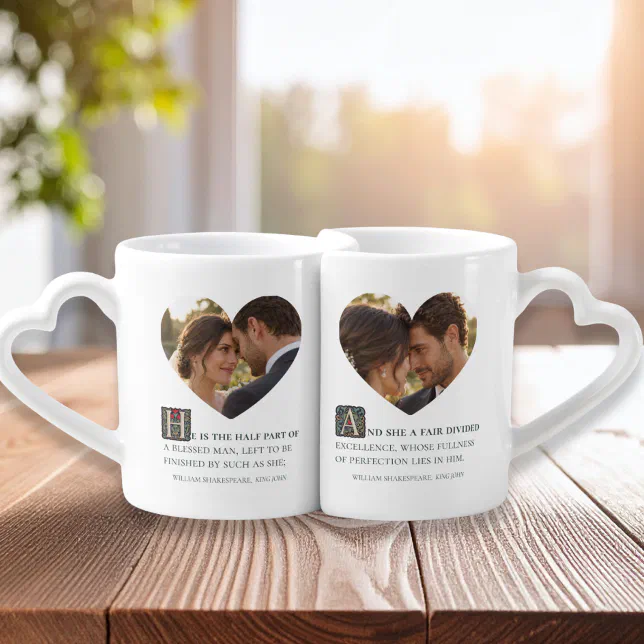
- The His & Hers Heart Photo Mug Set. Each mug carries half the verse and a heart-framed photo, and the heart-shaped handles fit together. His mug shows her photo, and hers shows his.
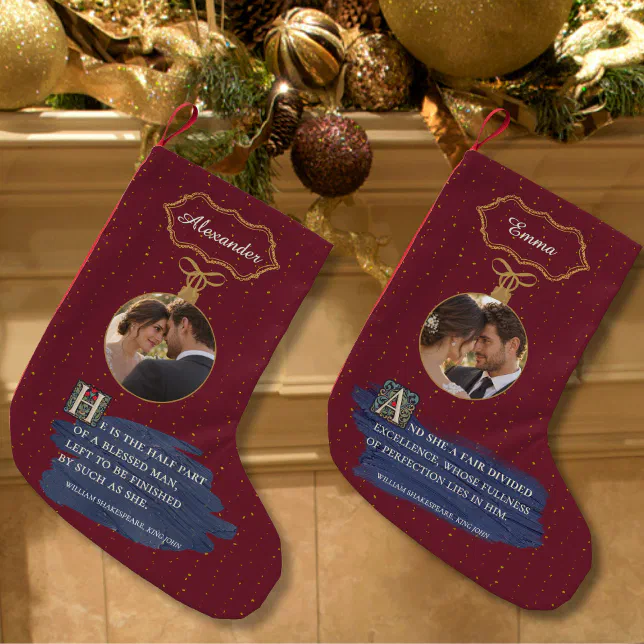
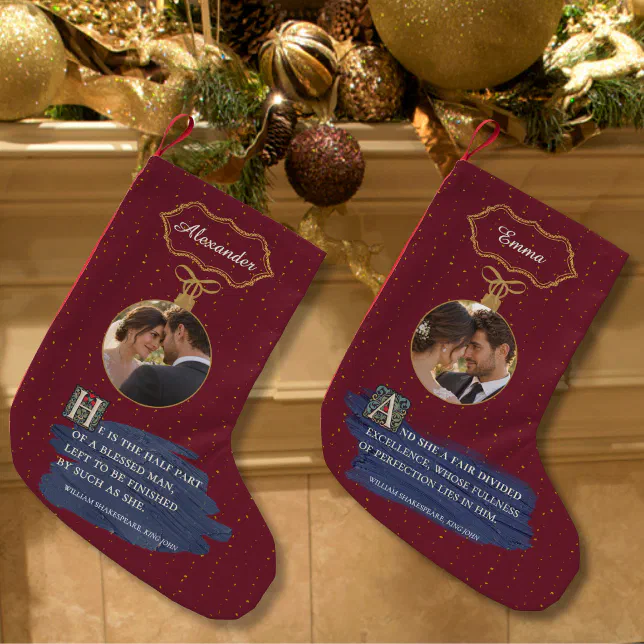
- The His and Her Christmas photo stockings, for a first Christmas married. Hung side by side, they finish the quote.
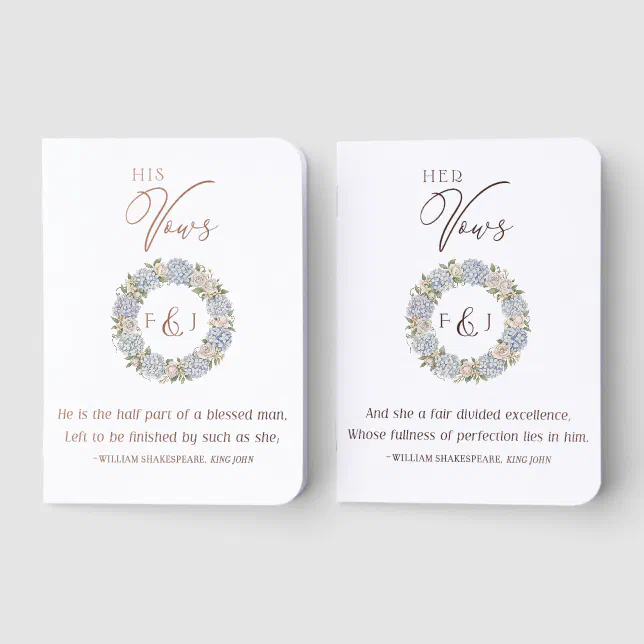
- The His and Hers Floral Wedding Vow Books, for the ceremony itself.
They make good engagement, wedding and anniversary gifts, especially for a couple who like a story behind the words. Now you have one to tell.
Header image: the coronation of Louis VIII and Blanche of Castile in 1223, from a 15th-century copy of the Grandes Chroniques de France. Public domain.
You might also enjoy
Did Shakespeare Ever Write About Christmas?
Not much. But the few lines he did write tell you a lot about what Christmas felt like in his London.
LiteratureMy Library Was Dukedom Large Enough: A Short Guide to Bookplates
What an ex libris is, where bookplates came from, and two Shakespeare lines about loving books, one of them from his bloodiest play.