
Short answer: barely. There's no Christmas play, no Christmas scene, nobody hanging a stocking. The word itself only turns up a handful of times in everything he wrote, usually in passing, as part of a joke or a complaint.
Those passing mentions are worth a look, though. They show what Christmas meant to Shakespeare's audience, which had less to do with presents and more to do with late nights, feasting and plays. Here are the ones worth knowing, plus a couple of lines that aren't about Christmas at all but probably should be.
The rooster that crows all night (Hamlet)
Hamlet opens in the cold and the dark. It's past midnight, a few soldiers are on watch, and a ghost has just walked past them. Then one of them, Marcellus, says this:
"Some say that ever 'gainst that season comes
Wherein our Saviour's birth is celebrated,
The bird of dawning singeth all night long;
And then, they say, no spirit dare stir abroad;
The nights are wholesome; then no planets strike,
No fairy takes, nor witch hath power to charm,
So hallow'd and so gracious is the time."
He's repeating an old country belief: in the days before Christmas, the rooster crows all night, and while it does, nothing that walks in the dark can hurt you. It lasts seven lines and then the scene moves on. It's still the closest Shakespeare ever came to writing a Christmas carol, and he put it in the first scene of his most famous tragedy.
Berowne doesn't want roses in December (Love's Labour's Lost)
In Love's Labour's Lost, the King of Navarre and three friends swear to spend three years studying, fasting and avoiding women. Berowne signs up, but he thinks the whole thing is ridiculous and tells them so:
"At Christmas I no more desire a rose
Than wish a snow in May's new-fangled shows,
But like of each thing that in season grows."
His point is that everything has its time, and making young men live like monks is as silly as wanting roses at Christmas. Four hundred years later, it works just as well as a complaint about Christmas displays going up in September.
Christmas meant theatre
In Elizabethan England, the twelve days of Christmas were the big season for entertainment: feasts, masques, dancing and plays. Shakespeare's company performed at court over the holidays most years. So when his characters say "Christmas," they often mean a show.
Later in Love's Labour's Lost, the men turn up to woo the ladies disguised as Russians. The ladies see straight through it and swap masks to confuse them. Berowne works it out too late:
"I see the trick on 't: here was a consent,
Knowing aforehand of our merriment,
To dash it like a Christmas comedy."
A Christmas comedy, in other words, was something everyone felt free to heckle.
The Taming of the Shrew has the funniest version. Before the main story starts, a drunk tinker named Christopher Sly is carried into a lord's house and tricked into believing he's a nobleman. When he's told that actors have come to perform a comedy for him, he asks:
"Is not a comonty a Christmas gambold or a tumbling-trick?"
Comonty is his word for comedy, and a gambold is a gambol, a bit of capering about. He's expecting acrobats. What he gets is The Taming of the Shrew.
Twelfth Night: named after the party
Twelfth Night never mentions Christmas. The title points to the last night of the Christmas season, the evening before Epiphany, which was traditionally the rowdiest night of the holidays: cake, drinking, games, and a world turned upside down for one evening.
Shakespeare never explains the title, and the subtitle, What You Will, sounds a lot like a shrug. But the play fits the night it's named for. A grand household is turned on its head, the servants stay up drinking and singing past midnight, and a pompous steward is tricked into wearing yellow stockings. The earliest performance on record was on February 2, 1602, at Middle Temple Hall in London. We know about it because a law student named John Manningham wrote it up in his diary.
It's also where one of Shakespeare's best party lines comes from. Late at night, Feste, the household fool, sings a love song to the drinkers that includes:
"Present mirth hath present laughter;
What's to come is still unsure."
It's a song about not waiting around, and it makes a good motto for the holidays. Enjoy the people in the room while they're there.
A sad tale's best for winter (The Winter's Tale)
In The Winter's Tale, the queen asks her young son Mamillius to tell her a story. Merry or sad, he asks. As merry as you like, she says. He has other ideas:
"A sad tale's best for winter. I have one
Of sprites and goblins."
He starts it ("There was a man... dwelt by a churchyard") and drops his voice so the crickets won't hear. Then his father storms in, and the whole play falls apart. We never find out how the story ends.
Ghost stories on long winter nights are an old habit. Dickens didn't invent the idea with A Christmas Carol. He was writing into a tradition Mamillius would have recognised.
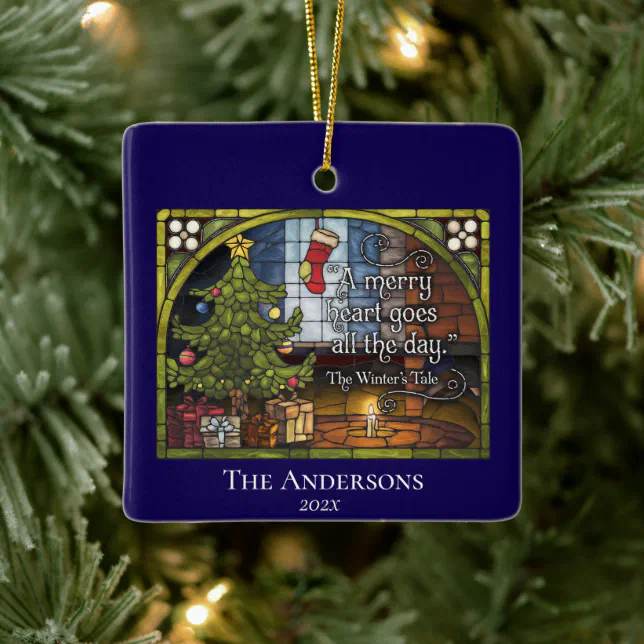
The same play gave us "A merry heart goes all the day," sung by Autolycus, a cheerful pickpocket, as he strolls off from robbing someone. It's still a lovely line. You can leave out the context.
Putting him on the tree
Shakespeare didn't leave us a Christmas classic. He left a rooster crowing all night, a drunk waiting for tumblers, and a boy whispering a ghost story to his mother. That's plenty to work with.
If you'd like some of it on your own tree this year, two of these lines are on ornaments in the shop: the Present Mirth ornament and the A Merry Heart stained glass ornament. The rest of our Christmas picks, from wine bags to stockings, are in the Christmas gift guide.
Header image: Jacob Jordaens, The Bean King (c. 1638), a Twelfth Night feast. Royal Museums of Fine Arts of Belgium. Public domain.
You might also enjoy
Shakespeare's Best His-and-Hers Quote Started as a Peace Deal
The lines on our his-and-hers mugs and stockings come from King John, where they're a sales pitch to stop a war. The real couple did better than the play lets them.
LiteratureMy Library Was Dukedom Large Enough: A Short Guide to Bookplates
What an ex libris is, where bookplates came from, and two Shakespeare lines about loving books, one of them from his bloodiest play.