
"Is Shakespeare written in Old English?" turns up on just about every list of the questions people ask most about him, usually somewhere near how he died and whether he really wrote his own plays. It's easy to see why. The thees and thous look ancient, and a lot of us met him in a classroom where he felt about as friendly as a tax form.
The short answer is no. Shakespeare wrote in Early Modern English, which is our English, just an earlier version of it. Old English is something else entirely.
What Old English actually looks like
Old English was spoken in England from roughly the 400s until a little after the Norman Conquest in 1066. Its best known poem is Beowulf, and the only copy to survive was written down around the year 1000. (That's its first page at the top of this post.) It opens like this:
"Hwæt! We Gardena in geardagum,
þeodcyninga, þrym gefrunon"
Unless you've studied it, that's a foreign language. It uses letters we've since dropped, like þ (thorn) and æ (ash), and its grammar is closer to German than to anything you'd hear on the bus. Roughly, it says: Listen! We have heard of the glory of the kings of the Spear-Danes in days gone by.
The middle step: Chaucer
After the Conquest, English took in a huge amount of French, and by the late 1300s it had become Middle English. That's what Geoffrey Chaucer used for The Canterbury Tales:
"Whan that Aprille with his shoures soote
The droghte of March hath perced to the roote"
You can almost read it. Say it out loud and it gets easier: when April, with its sweet showers, has pierced the dryness of March to the root. The spelling is strange and a few words have disappeared, but it's English.
Where Shakespeare fits
Shakespeare was born in 1564, more than 160 years after Chaucer died, and English had moved on again. Linguists call what he wrote Early Modern English. It's also the English of the King James Bible, which came out in 1611, while Shakespeare was still writing for the stage.
Here's the start of Sonnet 18, with nothing changed but the spelling:
"Shall I compare thee to a summer's day?
Thou art more lovely and more temperate"
No translation needed. The linguist David Crystal, who spent three years compiling a dictionary of Shakespeare's words with his son Ben, worked out that modern English speakers already know about 90 per cent of the words Shakespeare used. The other 10 per cent is where people get stuck.
What actually trips people up
It usually isn't the old words you can see coming. Most editions explain those in the margin, and plenty of them you can guess anyway. Morn is morning. O'er is over.
Thou and thee. Both just mean "you." In Shakespeare's day, thou was for a friend, a lover, a child or a servant, and you was the polite form. When two characters switch from one to the other in the middle of a scene, something between them has usually just shifted.
The -eth and -est endings. Thou art, she hath, it droppeth. In The Merchant of Venice, Portia says mercy "droppeth as the gentle rain from heaven." Read droppeth as drops and you've got it.
Words that look familiar but aren't. Crystal calls these false friends, and they're the sneaky ones, because nothing tells you to look them up. In As You Like It, Jaques says "all the men and women merely players." We hear merely as "only," but back then it meant "completely." He isn't saying we're only actors. He's saying we're actors through and through. And when Ophelia says Hamlet has been "blasted with ecstasy," she doesn't mean he's happy. Ecstasy meant madness.
Wherefore. This is the famous one. When Juliet says "O Romeo, Romeo, wherefore art thou Romeo?" she isn't looking for him. Wherefore means why. She's asking why he has to be a Montague, the one family she can't have, and her next line spells it out: "Deny thy father and refuse thy name."
So why does it feel so hard?
Partly because most of us read it instead of watching it. These are scripts. They were written to be heard by a crowd standing in a theatre, and many of the people in that crowd couldn't read at all. Actors carry a lot of the meaning in their voices and faces, and none of that shows up on the page. If a scene isn't making sense, find a production, or even a clip of the one speech, and listen to it. You'll be surprised how much clears up.
The other reason is that some of what he's saying is genuinely difficult. Crystal makes this point as well. A hard idea stays hard no matter how modern the spelling is, and Hamlet would be a challenging play in any century.
Where to start
If you want to ease in, start with the short lines. The old grammar does the least damage there, and the meaning arrives in one go. A few we've put on things:
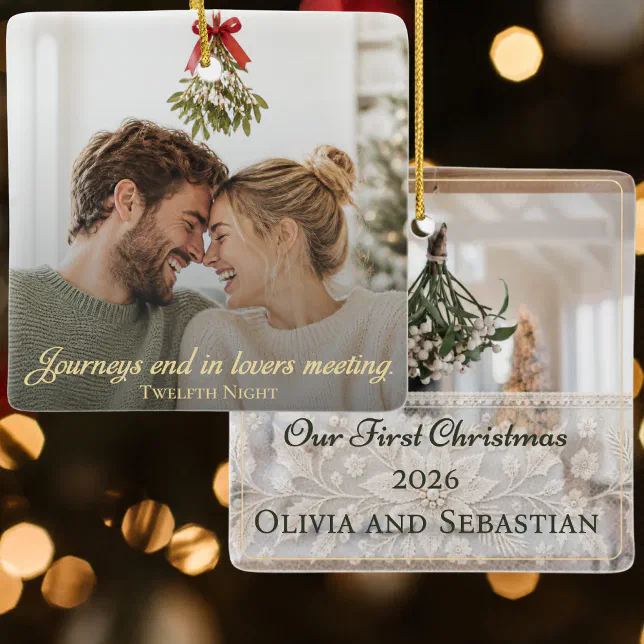
- "Journeys end in lovers meeting," from Feste's love song in Twelfth Night. Not one word of it needs explaining, and it's on our mistletoe photo ornament.
- "A merry heart goes all the day," sung by Autolycus in The Winter's Tale, on our family photo Christmas card.
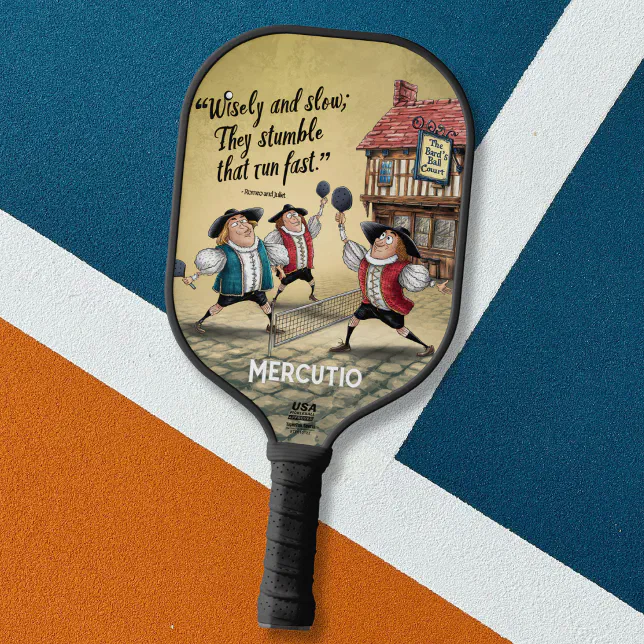
- "Wisely and slow; they stumble that run fast." That's Friar Laurence advising Romeo, and it works just as well at the kitchen line on our pickleball paddle.
- Hamlet's answer when Polonius asks what he's reading: "Words, words, words." It needs no help at all, and it's on our phone case.
Shakespeare didn't write in a dead language. He wrote in ours, as it sounded about 400 years ago, and you can already read most of it.
Header image: the first page of Beowulf, Cotton MS Vitellius A XV, f. 132r, written around the year 1000. British Library. Public domain.
You might also enjoy
Did Shakespeare Ever Write About Christmas?
Not much. But the few lines he did write tell you a lot about what Christmas felt like in his London.
WeddingShakespeare's Best His-and-Hers Quote Started as a Peace Deal
The lines on our his-and-hers mugs and stockings come from King John, where they're a sales pitch to stop a war. The real couple did better than the play lets them.