
If you lend books, you've lost books. Bookplates are the old, polite fix for that: a label inside the front cover that quietly says whose book this is, and where it should go back to.
What "ex libris" means
Ex libris is Latin for "from the books of." It's the traditional heading on a bookplate, followed by the owner's name, and these days people use "ex libris" and "bookplate" more or less interchangeably.
The idea is old. One of the earliest printed bookplates we know of dates from around 1480. It was made for Hilprand Brandenburg, who gave his books to the Carthusian monastery at Buxheim in southern Germany, and it's a hand-coloured woodcut of an angel holding a shield with an ox on it. (That's it at the top of this post.)
For centuries, bookplates belonged to people with serious libraries: aristocrats, scholars and colleges, often with a family coat of arms worked into the design. Now they're for anyone with a shelf they care about, including teachers with classroom libraries, book clubs, and the little free libraries on people's front lawns.
Prospero's library (The Tempest)
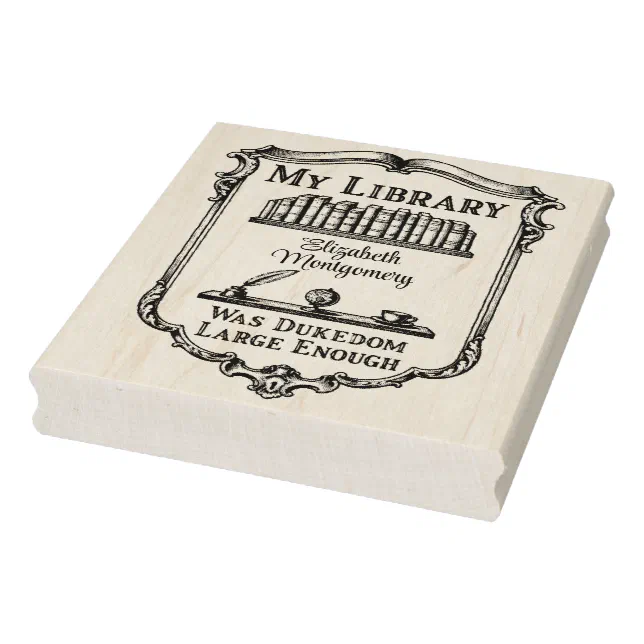
The line on our bookplates comes from The Tempest. Prospero, the old magician, is explaining to his daughter Miranda how the two of them ended up on an island:
"Me, poor man, my library
Was dukedom large enough."
It sounds cosy. It's actually a confession. Prospero was the Duke of Milan, but he was so wrapped up in his books that he left his brother Antonio to run things. Antonio took over, had Prospero and Miranda put out to sea in a rotten boat, and kept the dukedom for himself.
What saved them was a friend. Gonzalo, a kind old counsellor, made sure the boat had food, fresh water and clothes, and something else besides:
"Knowing I loved my books, he furnish'd me
From mine own library with volumes that
I prize above my dukedom."
Any book lover will recognise the type. He lost an entire duchy by reading too much, and what he's still grateful for, twelve years later, is that somebody packed his books.
Titus's library (Titus Andronicus)
The other library line comes from a much darker place. In Titus Andronicus, Shakespeare's bloodiest play, Titus's daughter Lavinia has been brutally attacked and left unable to speak or write, and her family has no idea who did it.
In one scene she keeps pulling at her young nephew's schoolbooks, desperate to find something. Titus, trying to understand, offers her his whole library instead:
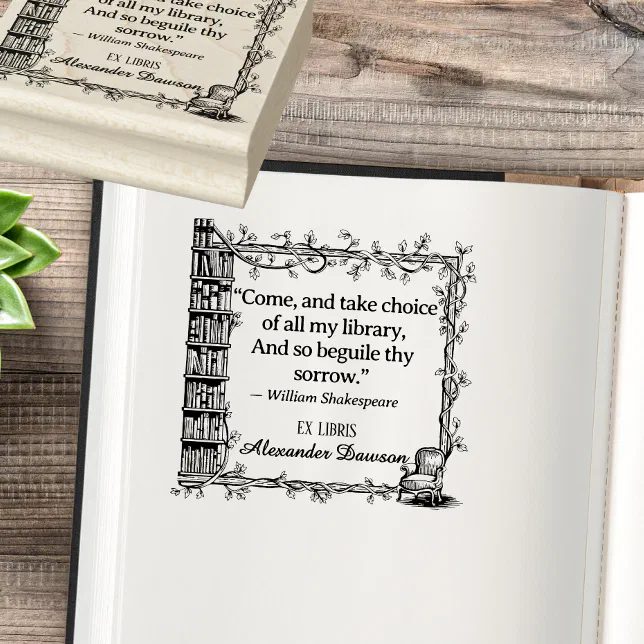
"Come, and take choice of all my library,
And so beguile thy sorrow."
To beguile sorrow is to distract from it, to help the hours pass a little more gently. Lavinia does find what she's looking for, though not the way Titus means. She turns up Ovid's Metamorphoses, opens it to the story of Philomel, a woman who suffered the same crime, and that's how she finally tells her family what happened.
Taken on its own, it's one of the kindest things anyone says about books in all of Shakespeare: take whatever you need and let it carry you for a while. In the play, it's the moment a book gives Lavinia her voice back.
Stamp or sticker?
Bookplates come in two main forms, and they suit different readers.
Rubber stamps are best when you've got a lot of books to mark, like a classroom library. One stamp does hundreds of books. Stamp the blank page inside the front cover, use an ink pad made for paper, and give it a minute to dry before you close the book. Skip glossy pages, which smudge.
Sticker bookplates look more like the traditional kind. They're easy to line up neatly, and they're nice to give alongside a book as a gift. Press from the middle outward so no bubbles get trapped.
For a rare or valuable book, skip both and tuck a loose bookplate inside the cover instead. Collectors prefer books that haven't been glued or stamped.
Our versions:
- The Classic Vintage Library Bookplate Rubber Stamp: Prospero's line in an engraved frame, with a shelf of old books, a quill and inkpot, and your name in script.
- The Shakespeare Library Bookplate stickers: the same design in soft ivory and navy.
- The Elegant Ex Libris Rubber Stamp: Titus's line, with climbing vines, a tall bookshelf and an armchair.
A sheet of bookplates also makes a good stocking stuffer for the reader in your life, especially tucked inside a new book with the first plate already in place.
Header image: bookplate of Hilprand Brandenburg of Biberach, hand-coloured woodcut, about 1480. New York Public Library. Public domain.
You might also enjoy
Did Shakespeare Ever Write About Christmas?
Not much. But the few lines he did write tell you a lot about what Christmas felt like in his London.
WeddingShakespeare's Best His-and-Hers Quote Started as a Peace Deal
The lines on our his-and-hers mugs and stockings come from King John, where they're a sales pitch to stop a war. The real couple did better than the play lets them.